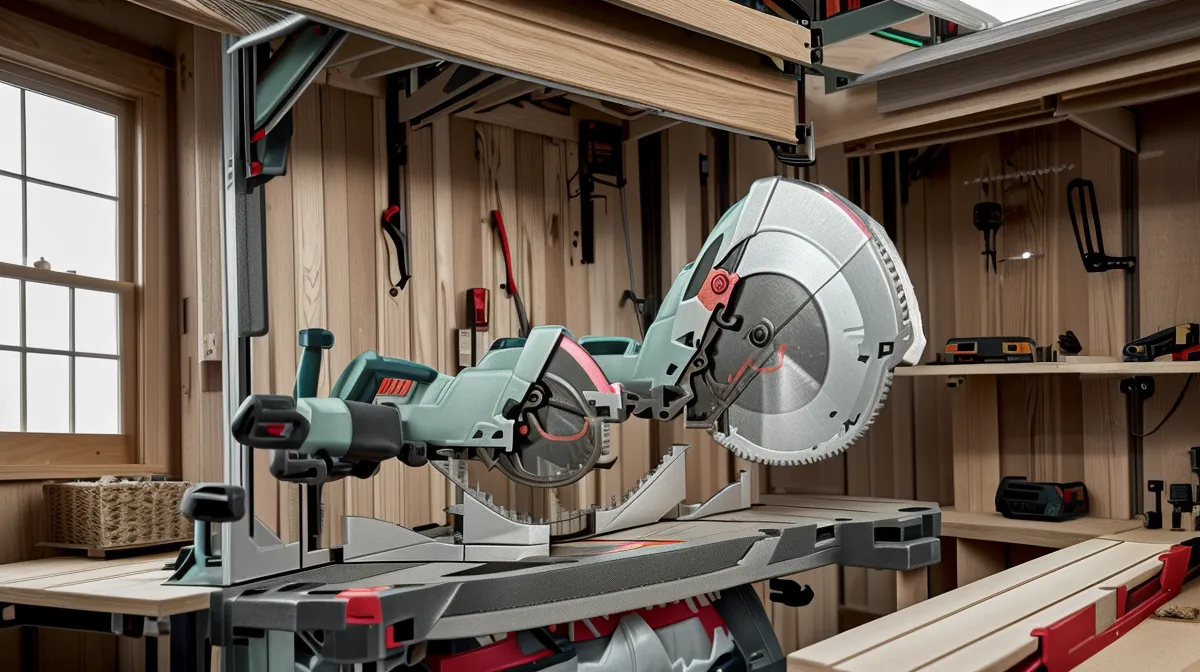
A three-inch gap where a twelve-inch miter saw is supposed to sit does not get any smaller no matter how long you stare at it. I found that out building a wall-mounted miter saw station into my half of a two-car garage workshop in suburban Minneapolis, and it's the kind of arithmetic mistake this guide exists to help you skip. Getting from a stack of woodworking plans to a station that folds flat for the car, holds a saw dead level, and repeats a cut to the same length without a tape measure comes down to a handful of decisions most tutorials gloss over — where to put the walls, how to account for plywood thickness, and how to keep two folding wings in the same plane. That's the shop organization problem this build actually solves.
Picture the alternative first: a miter saw balanced on a bucket, one sawhorse a couple inches taller than the bucket, and a full sheet of plywood you're trying to crosscut without losing a finger. That was roughly my setup before this build, and it's a genuinely bad way to spend a Saturday. The station fixes three problems at once: it gets the saw off improvised furniture, it gives long boards support on both sides of the blade so they don't dip and bind mid-cut, and it turns "cut this to 24 inches" into a repeatable setting instead of a fresh measurement every single time.
Why a Wall-Mounted Miter Saw Station Wins in a Small Garage Workshop
Floor cabinets are the default because most plans assume you've got a dedicated shop. Wall-mounting flips that assumption: the station's footprint drops to a few inches of depth when the folding wings are down, which matters when a vehicle needs to fit in the same space every night. Fold the wings up and out, and you get several feet of coplanar support on either side of the blade — enough to crosscut an eight-foot board without a helper. This is a build-versus-buy call as much as a design one: a plywood station runs you about a weekend of shop time, where a commercial folding stand either comes up short on wing length or is too long to fit against a two-car garage's back wall.
The design logic borrows more from how I plan software rollouts than from any woodworking course — small modular pieces you can adjust independently instead of one rigid structure you build once and live with. I've written before about treating a shop like an Agile Woodworking project instead of a waterfall one, and a folding station is the clearest example: wings can be resized or rebuilt without touching the fixed center section, so a mistake in one part doesn't force you to redo the whole cabinet.
Materials, Cost, and the Plywood Math
Both the base and the wings are built from standard 3/4-inch plywood, picked up in 4-by-8 sheets from Menards on American Blvd in Bloomington. Plywood beats solid pine for this particular build — it won't cup or bow the way a wide pine panel can once the garage swings from summer humidity to a dry Minnesota winter, and you don't have to think about grain direction the way you would gluing up a panel from narrower boards. That's a separate rabbit hole worth its own deep dive; the short version is that the most satisfying grain match I've ever pulled off wasn't on this project at all, it was a walnut cutting board that came out of the clamps with the end grain lined up into a near-perfect checkerboard when I flipped it over. None of that finesse matters here — you want stable and flat, not pretty.
A full sheet by yourself in a cramped garage is its own workout — the kind that makes a gym session feel optional. Three sheets covered the whole station, plus the hardware for hinges, folding leg brackets, and the T-track. That's the entire material cost, and it undercuts a decent commercial stand by a wide margin without needing an ROI spreadsheet to prove it. If you'd rather draw the whole thing out yourself before buying anything, that's basically what Theo, a woodworker I know from a local hobbyist meetup, does — plans everything on graph paper before he'll touch a piece of plywood, which is its own kind of discipline I haven't fully adopted.
Your Garage Floor Is Lying to You
Level is a relative term in a garage. Most slabs, especially in this part of Minneapolis, are pitched slightly toward the door so water runs out instead of pooling, which means a perfectly square cabinet set on the concrete floor won't actually sit level. Since the station mounts to the wall studs instead of standing on the floor, the fix is to ignore the floor entirely: run a long level off the wall itself when marking the mounting cleats, check it in both directions, and treat the slab's slope as background noise rather than a problem to solve.
Skip this step and the saw table ends up slightly out of plane with gravity, which sounds academic until you're trying to cut a picture-frame miter and the joint won't close no matter how many times you swap blades. A four-foot level is long enough for most two-car garage walls; anything shorter and you're extrapolating over distance, which is how small errors get amplified into cabinet-sized ones.
Cutting the Center Opening Without Losing Three Inches
Here's the arithmetic mistake from the opening: I measured the saw's base width and cut the center opening to match it exactly, which works fine right up until you remember the opening also has two plywood side panels forming its walls. Three-quarter-inch plywood on each side adds a full one and a half inches you have to build into the opening's total width, on top of whatever clearance the saw's base needs to slide in and swivel through its full miter range. Skip that and you get a saw that's a few inches too wide for the hole you built for it — which is precisely what happened to me, and which meant ripping down and rebuilding the entire center section from scratch.
The rule that comes out of it: measure the saw, then add the combined thickness of every panel that will form the opening's walls, then add your swing clearance on top of that. Write all three numbers down before you cut anything — this is the one dimension on the entire station where getting it wrong means rebuilding, not shimming.
Rebuilding a center section means clamps and glue drying time you can't rush, so that gap in the schedule is a good excuse to work through the 4-hour scrap wood projects piling up from other builds instead of standing around waiting on the glue. It also happens to be when Marcus, the neighbor who eventually built his own small shop after watching me work, tends to show up with a six-pack and questions about whatever's clamped up on the bench — cheap admission for an extra set of hands holding boards square while the glue sets.
T-Track and Stop Blocks for Repeat Cuts
A T-track is just a metal channel that lets a stop block slide to a set position and lock down with a knob — no more re-measuring every board in a batch. Set the stop at whatever length you need, and every board after the first one gets cut to that exact length by butting it against the stop instead of the tape measure. For a run of shelf boards or drawer parts that all need to match, that's the difference between twenty consistent cuts and twenty boards that are each a little bit different from the last.
None of this replaces good joinery — a stop block gets you consistent lengths, not square corners or tight-fitting joints, which is still a separate skill built through repetition rather than hardware. But consistent lengths make every joint downstream easier to dial in, because you're not compensating for a board that's an eighth-inch off from its neighbor before you've even started cutting the joint itself.
Keeping the Fence Co-Planar
The fence is the back edge you press a board against before cutting, and on a two-wing station it has to sit in exactly the same plane on both sides of the blade. If the left wing's fence sits even a sixteenth of an inch forward of the right wing's, a long board bows slightly across the gap, and the two ends of a miter joint won't meet flush no matter how carefully you cut the angle. Check this with a straightedge laid across both wings before locking anything down permanently — sight along it with the saw's table as the reference plane, not the wall or the floor.
By the time both wings checked out flat, the light through the half-open garage door had dropped into that low orange stripe across the floor that shows up every afternoon this time of year — a decent, if accidental, reminder to wrap up before the good measuring light goes and you start eyeballing gaps you should be checking with a square.
Zero-Clearance Inserts and Dust Control
Zero-clearance inserts are sacrificial strips of scrap that sit directly under the blade path, replacing the wider factory opening with one the blade itself cuts on first use. They back up the wood fibers right at the cut line, which stops the underside of a crosscut from splintering out — the difference between an edge that looks cut and one that looks torn. They're cheap, they wear out, and you replace them without touching anything else on the station.
A shop-vac hose clamped to a port on the back of the cabinet handles most of the dust a miter saw throws, and it's worth doing even a basic version — I've written separately about dust collection on a budget, and a station like this is an easy place to add a port since the cabinet back is already enclosed. Finishing the station itself doesn't need much thought since it's shop furniture, not furniture furniture, but it's a good reminder that not every finishing mistake is fixable after the fact — I once skipped wood conditioner on a pine project because I was in a hurry, and the stain went on blotchy and streaky in a way no amount of extra coats fixed afterward. Plywood edges on a cabinet like this don't drink stain unevenly the same way raw pine does, so it's one corner you genuinely can skip cutting on this particular build.
What I'd Tell You Before You Start
Three things are worth knowing before you start cutting plywood. Wall-mounting is the right call for any garage that still needs to park a car — folding wings give you the support of a much bigger station without the permanent footprint. The floor is not a trustworthy reference in most garages, so use the wall and a level instead of assuming a square cabinet will sit level on its own. And material thickness has to be added into every opening you cut, not just accounted for in your head — three-quarter-inch plywood is genuinely three-quarters of an inch, and skipping that math is how you end up staring at a gap that's exactly as wide as two plywood side panels.
Working through a Minnesota winter adds its own wrinkle to any garage build — cold glue and cold finish behave differently than either does in July, which is a separate topic on its own. Wall space is also the most underused real estate in a small shop; if a folding miter station convinces you of that, a french-cleat panel for clamps and jigs is usually the next thing worth building. Either way, the return here isn't measured in dollars so much as in floor space you get back every single night — which, in a garage this size, is the only metric that actually matters.