How exactly do you convince a homeowners association that a wooden box full of dirt isn't a permanent structure? I never got a clean answer, but building three cedar raised garden beds this spring turned that question into a real design problem. My wife wanted something that looked like it belonged next to the patio, not a construction site. I wanted an excuse to test whether the woodworking plans piling up on my hard drive were worth the storage space. Somewhere between those two goals, a simple suburban homestead project became a genuine comparison between two different ways to build the same box.
Quick disclosure before we get into lumber math: this site runs on affiliate links, and if you buy a plan or product through one of them, I earn a small commission at no extra cost to you. I only point people toward stuff I've actually used in my own garage, usually while fixing a mistake I made about twenty minutes earlier.
My wife's version of this idea started on a walk at Minnehaha Falls Regional Park, watching how the park's planted beds handled the same heavy clay we have in our own yard. Mine started with a spreadsheet.
Anchored Posts or a Floating Frame: The Real Decision Behind a Cedar Raised Garden Bed
Every raised bed guide on the internet assumes you can sink posts straight into the ground and call it finished. That works fine if you own your yard outright and nobody's checking. It does not work in a townhouse-style development where the HOA treats anything bolted into the earth as a "permanent structure" that needs approval I did not have time to chase. So before I touched a single board, I went back through the stack of woodworking plans I've been collecting like some people collect vinyl records, looking for anything that addressed a modular, non-anchored build. Most didn't. That's worth knowing if you're shopping plan libraries instead of just improvising the whole thing.
I've made this mistake before. My first bookshelf turned into a lesson in why blueprints exist, and I wasn't about to skip the planning step twice in the same hobby. This time the requirement wasn't just "build a box". It was about building a box that survives a Minnesota winter and doesn't trigger a warning letter. That second part ruled out the standard anchored-post approach and pointed toward something closer to a floating frame: cedar boxes held in place by weight and geometry instead of hardware driven into the yard.
Picture the difference the way you'd picture two ways of shipping a feature. Anchored posts are the monolith. They're bolted straight into production, hard to move once it's live, rock solid if nobody ever needs to relocate it. A gravity-set modular frame is closer to a container: it runs independently, doesn't touch the host environment, and you can pick the whole thing up and move it if the requirements change later. Neither approach is objectively better. They solve different problems.
What Each Approach Costs You in Lumber, Time, and Species Choice
Cedar isn't the cheapest board in the rack, and I won't pretend the anchored-post crowd doesn't save real money by going with pressure-treated pine instead. But Western Red Cedar carries natural oils that resist rot and insects for somewhere in the ten-to-fifteen-year range without any chemical treatment, which matters when the alternative is rebuilding a bed every few seasons. For three beds sized four feet by eight feet and standing eleven inches tall (two stacked 2x6 boards), I worked out I needed eighteen boards of 2x6x8 cedar, which is not a small stack to haul home in one trip. The moment a blade drops into a fresh board, cedar lets go of a sharp, almost peppery scent that pressure-treated pine never manages. That's a small bonus, but a real one.
If you're trying to decide which species fits your own build, that decision genuinely deserves its own reference table rather than a paragraph buried in a garden bed post. Species selection changes depending on whether the wood's staying dry indoors or getting rained on for a decade. Wood movement is a separate headache worth understanding on its own, too: outdoor cedar expands and contracts with the seasons in ways indoor furniture never has to deal with, and that's a rabbit hole for another post. Weight matters just as much once the wood is part of a modular design, though. A single cubic yard of garden soil runs somewhere around 2,000 to 2,400 pounds, which is exactly what keeps a gravity-set frame from wandering around the yard without a single screw touching the dirt underneath it.
None of this happens on a workshop budget planned out in advance, either. Cedar for three beds is a different line item than what I'd normally set aside for one indoor project, and anyone doing this seriously should treat it as its own budget category instead of folding it into general shop expenses.
The Joinery Decision Nobody Warns You About
The modular approach lives or dies on joinery, not brute strength. Instead of sinking 4x4 posts, I built each corner with internal cedar cleats (2x4 blocks screwed to the inside face of the frame), sitting above the ground so nothing extends down into the dirt. The joint has to be tight enough that the frame holds its shape under soil pressure without any post doing the structural work for it (which is the part every anchored-post guide skips over). That's a different problem than a butt joint on an indoor project, where gravity is doing you a favor instead of trying to spread your corners apart.
Assembly exposed a different problem: my driveway looks flat until you try to build a precision box on top of it. I squared up the first frame right there on the concrete, stepped back, and realized I'd built a parallelogram, a slope meant for drainage that I'd never consciously noticed had tilted the whole thing just enough to throw off square. I backed the screws out and moved the entire operation onto my sturdy workbench, which sits on a section of garage floor I'd already confirmed was level. Trust the surface built for the job, not the nearest flat-looking one.
I got this wrong once already, on a different piece entirely. I drove pocket screws into a face frame before clamping it properly, and every joint in that project skewed by a couple of millimeters I didn't notice until glue-up. Clamp first, screw second, always, no matter how much the weekend is pushing you to rush. It's the woodworking version of writing the test after the code ships because the deadline landed on a Friday.
A reader named Priya Sundaram emailed me a version of the same question after the walnut cutting board post went up. She documents pretty much every step of her own builds on a dedicated Instagram account, and she wanted to know whether pocket screws were structurally honest or just a shortcut. Grain direction plays into that conversation too, especially on any board that ends up as a visible cap rail, though that's really a topic for a different post. For the raised beds, the honest answer is that pocket screws are fine as long as the joint is clamped first, which is exactly the kind of thing you only really internalize after debugging joinery gone wrong a few times.
These days, most of my indoor glue-ups come out clean enough that I can run a finger across the seam right after the tape comes off and not feel where one board ends and the next begins. Outdoor cedar boxes don't reward that kind of precision the same way. Nobody runs a finger along a raised bed corner checking for a flush joint; they check whether the frame holds a few hundred pounds of wet soil without bowing. Different craft, different measure of success.
Scribing a Slope vs. Shimming It Flat
Getting the frames level in the actual yard turned into its own comparison. My backyard looks flat until a tape measure proves otherwise. One eight-foot bed had roughly a four-inch drop from one end to the other once it sat where it was actually going to live. Shimming is the fast fix: stack pressure-treated shims or gravel under the low corners until a level bubble sits still. It works, but the gap underneath becomes obvious the moment you look at the bed from yard height, and soil has a way of finding that gap and washing out through it after a hard rain. Scribing takes longer. You set the frame roughly in place, run a level along the top, transfer the slope onto the bottom board, and cut that angle so the top stays level while the bottom follows the ground. I chose scribing for two of the three beds and shimmed the third just to compare, which cost me an extra few hours with a hand plane I hadn't planned on using. The cheap combination square I'd been using for years turned out to be off by a degree or two, which is nothing on a small cut and everything once you're transferring an angle across eight feet. I picked up a better one halfway through and haven't trusted the old one since.
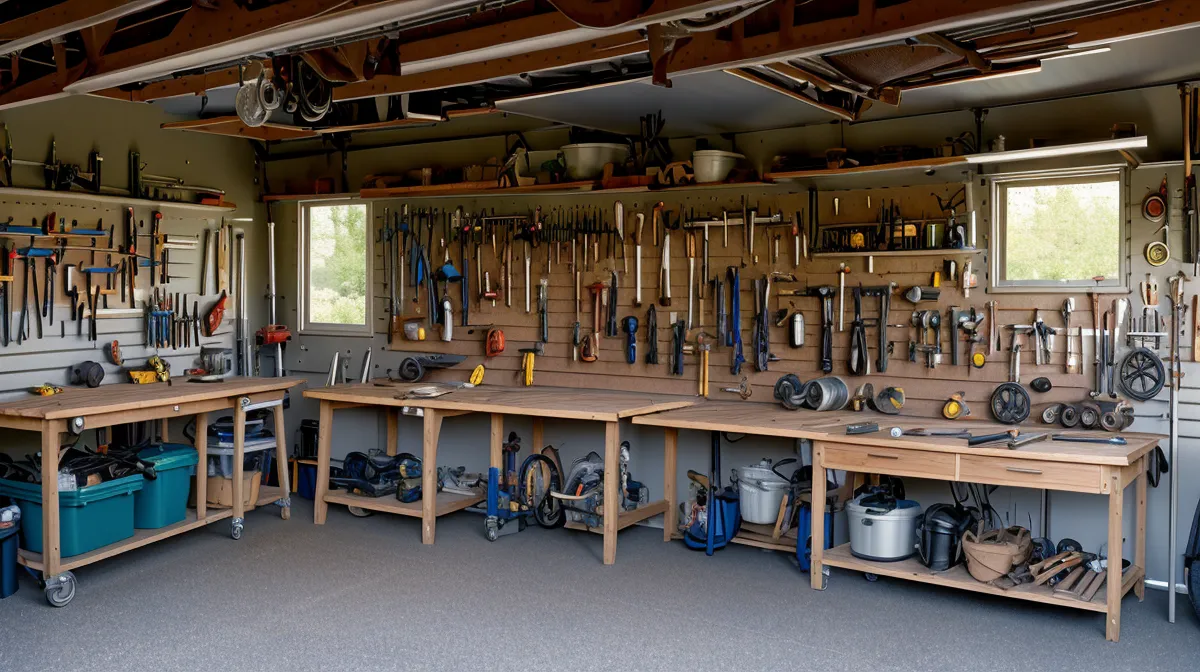
Scribing cuts kick up more dust than a straight rip, mostly because you're making small adjustment passes instead of one clean cut, and that's a good reminder that dust collection in a small garage is its own project worth solving before a build like this one. My own setup lives on a pegboard panel by the garage door, tools hung wherever I used them last instead of sorted by type, which drives my more organized friends a little crazy but means I can find the clamps without thinking about it.
One of my wife's book-club friends, Darlene Kowalczyk, stopped by while the beds were still bare wood and asked whether the cedar tone would clash with our house trim. She notices that kind of thing before anyone else would. It hadn't occurred to me to think about color at all; I was still solving a structural problem, not a design one. Cedar left unfinished usually weathers to a silver-gray on its own within a year or two, which is exactly what outdoor cedar tends to get, and that's a completely different finishing decision than anything I'd choose for a piece of furniture staying inside the house.
None of this happened in a warm space, either. The north wall of the garage stays uncomfortably cold through most of a Minnesota spring, and cutting scribe angles with stiff, cold fingers is its own skill worth a dedicated guide rather than a footnote here. A single fluorescent tube overhead and a clamp light aimed at the vise are enough to see a pencil line, even if neither one does much for the temperature.
So, Which Design Should You Actually Build?
Anchored posts make sense if you own the property outright, don't answer to an HOA, and want the simplest possible joinery with the least amount of math. Just sink treated 4x4s, screw the frame to them, and you're done. It's the more forgiving build for a first attempt at outdoor lumber work.
A gravity-set modular frame earns its keep when you're working around rules somebody else wrote, might need to relocate the beds in a few years, or just like that a raised bed can disappear without leaving a hole in the yard. It asks more of your joinery and your patience with a level, but nothing about it needs anyone's permission.
If you're shopping for plans instead of improvising the way I did, plan quality varies wildly between libraries, and that's worth its own honest review rather than a quick verdict buried at the end of a garden bed post. I lean on TedsWoodworking often enough that it's become my default starting point when a new project needs a real blueprint instead of a guess.
For anyone chasing the bigger suburban homestead picture (rainwater collection, small-scale food production, that kind of thing), I've also been paging through Self Sufficient Backyard, which covers more ground than pure woodworking plans do.
Sheds are a different animal entirely, and not one I'm tackling this season. They need real foundations (footings, drainage, something rated to hold weight and shed water away from the structure), which is a different engineering problem than three cedar boxes sitting on gravity. When I do get around to it, I'll be leaning on dedicated shed plans instead of improvising foundation work the way I improvised the bed design.
Three beds in, the soil's settled, and the neighbors haven't said a word about the HOA angle, which I'm counting as a win either way. Whichever approach you pick, the test that actually matters is simple: could you unbolt this and haul it away without touching a shovel? If the answer's yes, you built the modular version, on purpose or not.