
One bad glue line convinces many weekend woodworkers to scrap the whole project and start over, but that's an assumption worth pushing back on, because it's wrong, and I've got a cherry coffee table sitting in my garage workshop as proof. Joinery mistakes are not verdicts on the piece; they're diagnostic problems, and most of them have a fix that doesn't involve starting from scratch. Cherry furniture is forgiving that way, if you know how to read what went wrong. In my day job as an IT project manager, we'd call an unresolved bug technical debt: ignore it early and the whole system crashes at deployment. Woodworking runs on the same logic, except the deployment is a glue-up and the choice words come out louder.
My current build started the way a lot of ambitious projects do: I found a build video, watched it once, and started cutting parts before I'd downloaded the actual cut list. That shortcut caused five separate joinery mistakes on one cherry table, each a symptom of skipping the planning step and improvising joint dimensions on the fly. This is fairly standard woodworking territory, honestly, and none of the five sank the project. All of them needed a specific fix, which is really the whole argument here: debugging bad joinery is a normal, teachable skill, not a sign you should have bought furniture instead.
The workshop where all this happens is the north half of a two-car garage attached to a 1970s rambler in Brooklyn Park — concrete block on two walls, and the north side doesn't climb much past forty degrees from November through March no matter what the furnace is doing on the other side of the house. That matters because cold hands make for sloppy chisel work, and a couple of the mistakes below happened on days I should have just waited for the garage to warm up. None of it works without a bench that stays put while you're paring a shim to fit, either — mine's just construction lumber along the back wall, more pencil marks and dried glue at this point than visible grain, but it doesn't move when I lean on it, and that's really the only requirement.
What Joinery Type Are You Actually Cutting?
Before debugging anything, it helps to know what you're actually debugging, because not every joint fails the same way or for the same reason. A mortise and tenon relies on a snug mechanical fit between two parts — call it a piston fit, seated with firm hand pressure, with glue there for the long haul rather than to fill a gap. Dovetails work differently: interlocking pins and tails built to resist being pulled apart, which is why they show up on drawer boxes that take constant tension. Get either one wrong and the failure mode is different.
Pocket screws are a mechanical shortcut — quick, strong enough for cabinet carcasses, but unforgiving if the pieces aren't already aligned before you drive them, since the screw can walk the joint sideways instead of pulling it tight. Dowels and biscuits aren't structural joints at all; they're alignment aids that keep two glued faces from sliding while the clamps go on. Knowing which category you're working in tells you what kind of failure to expect. A loose mortise and tenon is a fit problem. A cracked dovetail is almost always a grain problem — more often than people admit, a joint that won't seat cleanly traces back to grain direction rather than clamp technique, and that's worth checking before you blame anything else. A skewed pocket-screw frame is a sequencing problem, not a wood problem at all.
The Loose Tenon: A Classic Joinery Mistake
On the current cherry table, I got a little aggressive with the shoulder plane and turned a tenon that should have needed firm hand pressure into something that just slid home and rattled around. A joint like that leans entirely on the glue's gap-filling properties if you leave it alone, which is a recipe for a wobbly table a season or two down the road, not a strong one.
The fix is closer to shimming a doorframe than anything fancy: pare a paper-thin shaving off a scrap of the same cherry, glue it to the cheek of the tenon, let it cure, then pare it back with a chisel until the fit is snug again. Match the species and the patch disappears under finish, because the grain orientation lines up with the rest of the joint. I've done this enough times on enough builds that I no longer treat it as a failure — it's routine maintenance, the woodworking equivalent of patching a bug instead of rewriting the whole module.
Closing a Gap Without Leaving a Dark Scar
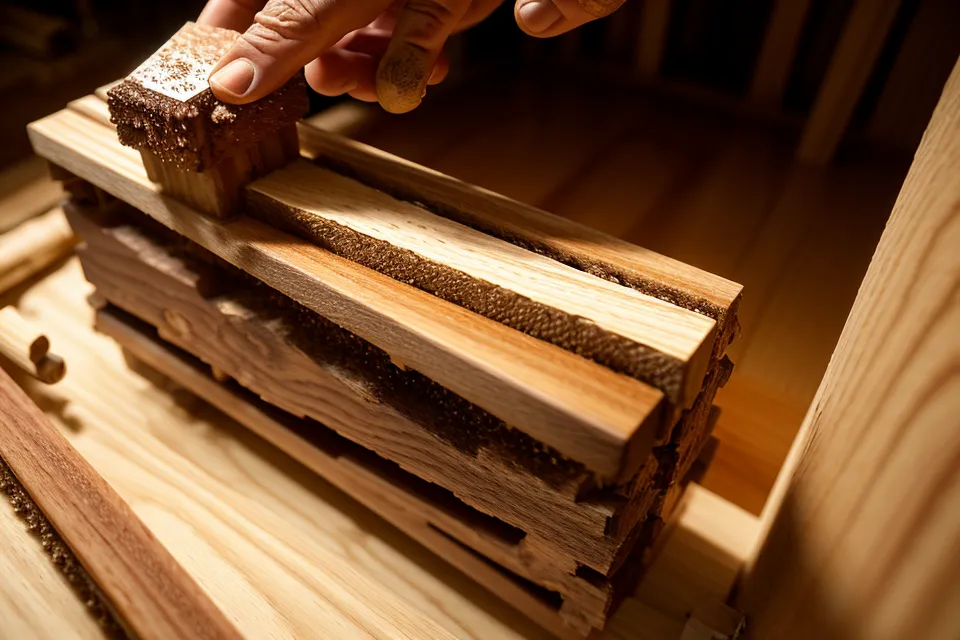
A gap wide enough to slide a Module_root__BamsY through showed up where an apron met a leg during a dry-fit — a slight twist in the leg from milling that nobody caught until the pieces sat next to each other. Sawdust mixed with glue is the tempting quick fix here, and on cherry it's usually the wrong one: the mixture dries into a dark, muddy scar that only gets worse as the wood ambers with age. I made that exact call on my mistakes building a DIY modern coffee table and regretted it the moment the finish went on, which is really a finishing-process lesson as much as a joinery one — a patch that looks fine in raw wood can turn ugly the second oil or stain hits it.
The better option is a Dutchman: a thin, tapered sliver of matching wood tapped into the gap with glue, then flushed off with a chisel once it's dry. Because it's actual wood fiber and not a paste, it takes finish the same way the surrounding board does instead of flashing a different color under the first coat.
Why Square Isn't Optional at Glue-Up
Nothing kills momentum like tightening the last clamp on a base assembly and watching the whole structure lean a quarter inch out of true. Half the time it isn't the wood at all — it's a clamp that isn't pulling evenly, and one of mine, picked up secondhand at Ax Man Surplus in St. Paul because it was cheap and I didn't check it closely enough, turned out to apply pressure unevenly on one side. A clamp you can't trust is its own kind of shop problem, separate from whatever system you use to store the rest of your gear — building a DIY woodworking clamp rack a while back helped me find the right clamp fast, though it did nothing to fix the one that was already bad.
If the glue is still wet, the fix is a diagonal clamp: measure both diagonals of the base, and if one is longer, run a clamp across it and tighten until the two measurements match. I know it worked on this table because the dry-fit carcass finally sat flat, all four corners meeting the concrete floor at the same time, no rocking, no daylight under any leg. Once the glue has set, you're past that option and looking at a structural fix instead, which on one earlier piece meant planing the bottoms of the legs to slightly different heights just so the thing would sit flat on an uneven floor.
Clamp Pressure, Wood Movement, and the Cracks You Don't See Yet
Overtightening is an easy habit to fall into — if firm pressure is good, more must be better, right up until the center of a glued-up panel lifts clean off the workbench because the boards are fighting the clamps instead of sitting flat. That's not just cosmetic. It's stored stress in the wood, and wood doesn't forgive stored stress once humidity starts moving.
Wood expands and contracts mostly across the grain — perpendicular to the growth rings — as the humidity around it changes; movement running along the grain is close enough to nothing that you can ignore it. A panel glued up without room to move across its width isn't stable, it's just quiet until the first humid stretch, at which point it cracks or buckles trying to expand somewhere it isn't allowed to go. Cauls help with the immediate bowing problem — straight scrap wrapped in packing tape, clamped across the panel to hold it flat while the pipe clamps do the actual squeezing — but they don't solve the movement question, which is about how the piece gets attached to whatever holds it, not how hard you clamped it during glue-up.
Snipe: Stop Sanding, Start Sacrificing Scrap
Snipe — that gouge a planer leaves at the very start and end of a board where the rollers apply uneven pressure — showed up on the underside of the aprons on this build, and cherry is merciless about hiding sanding attempts, since it shows every scratch and low spot once oil goes on. Trying to sand a divot level usually just makes a bigger, softer divot.
If the board is already cut to final length, a hand plane blended lightly across the sniped section, checked constantly against a straightedge, is the only real fix once it's happened. Feeding a piece of scrap through the planer immediately before and after the actual project boards is the fix that prevents it in the first place — the machine snipes the sacrificial piece instead. Cherry forgives some mistakes better than other species would, since it's soft enough to pare and patch cleanly, but that's really a separate conversation about picking the right wood for a project before you ever turn on a machine. I still don't have a great answer for what all that planing and sanding does to the air in an attached garage, and I'm not going to pretend the shop vac catches all of it.
The Real Lesson Is Diagnosis, Not Perfection
None of the patches on this table are invisible if you go looking. The shimmed tenon shows if you know to check the back leg. The Dutchman patch turns up under a flashlight, if you're the kind of person who crawls under other people's furniture. To guests, it reads as a solid, finished piece. That's really the point of all this: the myth that a mistake disqualifies the project only holds up if you never learn to fix what went wrong.
Some of what determines how many of these mistakes you'll hit in the first place comes down to how good the plan was before you started, and not every downloadable set of plans out there earns the same trust — it's worth checking a plan's actual dimensions against your own measurements before you cut anything. Pegboard, chisels, and a running list of the joinery mistakes I've already made and patched live along the wall by the garage door, sorted more by whatever I grabbed last than any real system, and that list has saved me from repeating a couple of these errors on later builds. Darlene Kowalczyk, my wife's book-club friend, left a five-star review so detailed after I built her a hall-tree coat rack that it namechecked the miter joints — proof, I think, that nobody outside the shop notices a patched tenon if the rest of the piece holds together. Most of the wood I don't use on a project like this ends up as shims, cauls, or scrap for smaller builds, which is how a 4-hour gift challenge using only scrap wood became its own small tradition around here. A joinery mistake, caught and diagnosed instead of panicked over, is just information — not a reason to start over.