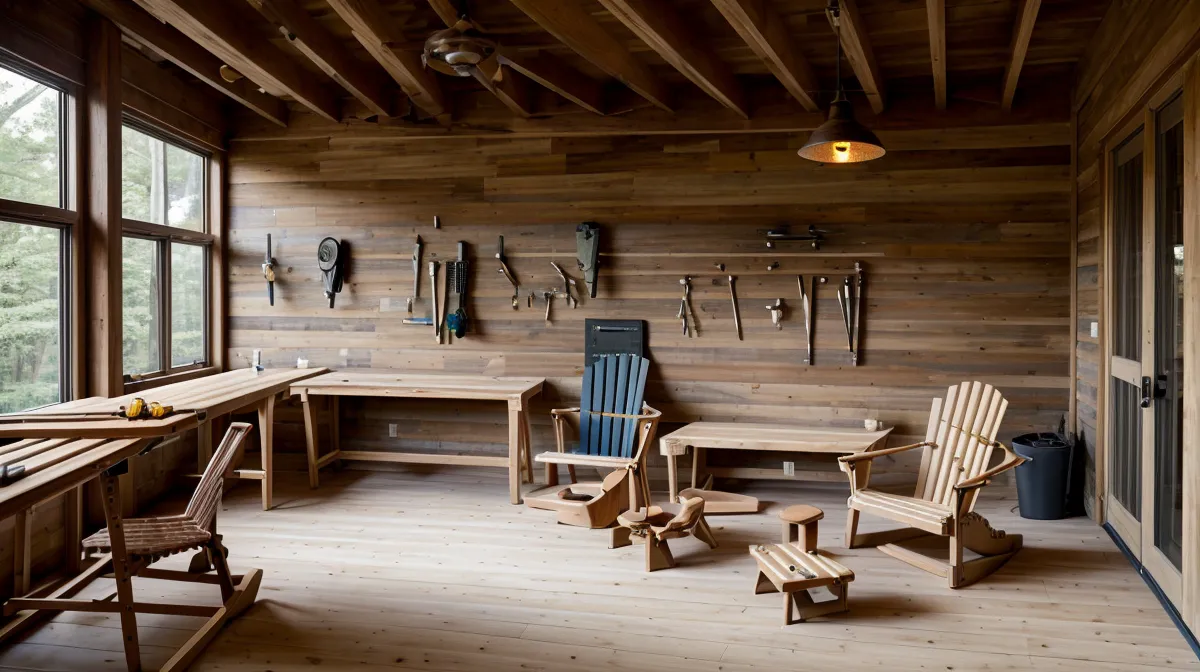
Eleven pieces of wood, cut from a single board — that's supposedly the entire original 1903 Adirondack chair design, cupholders and slatted backs be damned. That number comes up almost every time I talk about this build, because it's the detail nobody believes at first. Six years into running a weekend workshop out of half my garage, this one chair still generates more questions from readers than almost anything else I've built, and most of them circle the same thing: are professional woodworking plans for a piece of DIY outdoor furniture actually worth paying for, or is a decent free PDF close enough?
Short version, for anyone who wants it before reading further: the real upgrade a paid plan buys you over a free one isn't polish, it's fewer wasted board feet chasing a cut list nobody actually bothered to specify. Everything past this point is the Q&A version of actually building the thing, in roughly the order people ask it.
How Do You Know a Joint Is Actually Tight?
People ask this more than almost anything else, and the test I use has nothing to do with a caliper. I hold the joint up to the nearest light source I've got and look for daylight coming through. The first time a 45-degree miter came together clean on one of my builds — corner tight, not a sliver of light showing through the seam — I stood there turning it over in my hands for a solid minute like I'd won something. That's the bar. If light gets through, the angle's off, and no amount of wood filler fixes it invisibly (trust me, I've tried). I wrote a whole post cataloguing the specific ways I've gotten joinery wrong — Debugging My Joinery: 5 Common Woodworking Mistakes and How I Patched Them — if you want the extended cut of that particular education.
Should You Use Cedar, Pine, or Something Else?
Cedar is the answer for this chair, and I'd reach for it again on anything that lives outside year-round in a Minnesota climate. I'm not going to turn this into a full species breakdown — there's a separate glossary post on this site covering hardness, grain, and workability species by species, and that's the better place to go down that particular rabbit hole. What matters here is that cedar forgives more mistakes than pine does when you're gluing up curved slats, and it moves less across a season too, though wood movement in general is its own deep topic — deep enough that I gave it a full post on a dining table build where seasonal expansion actually caused real problems. Budget for more lumber than the cut list technically calls for either way; the cost adds up faster than a chair this size suggests, and I've broken down realistic garage-shop budget numbers elsewhere if that's useful to you.
Pocket Screws Are Fine, But the Order Matters
Somebody asked recently whether pocket screws are a shortcut you'll regret on outdoor furniture, and the screws themselves aren't the problem — the sequence is. On an earlier project I drove pocket screws into a face frame before I'd actually clamped it up, figuring the screws would pull everything tight on their own. Every joint ended up skewed by about two millimeters, which doesn't sound like much until you're staring at a frame that won't sit flat on a bench. Some of that was the clamps, too (the cheap quick-grip clamps I was using back then don't hold nearly enough pressure for a glue-up like that), and I've since switched to parallel clamps for anything that needs to stay dead flat while it cures. Clamp first, check it's actually square, then drive the screws. The screws are there to hold a joint that's already correct, not to fix one that isn't.
Workshop Basics: Bench, Dust, and Where Things Live
You don't need a fancy setup to build one of these, which is good, because mine isn't one. The workbench along the back wall of my garage is just construction lumber I bolted together years ago, and the top has more pencil marks on it by now than bare wood — there's a full post on building something sturdier if you're starting from scratch on a bench of your own. A miter saw station makes the repetitive angled cuts on a chair like this dramatically easier too; I wrote up how to build a DIY miter saw station for a small garage workshop after this project convinced me mine needed an upgrade. Dust is the other thing nobody mentions until their garage looks like a flour mill after a jigsaw session — I've got a separate writeup on keeping that under control on a normal budget, so I won't retread it here. Tool storage matters more than people think, too; mine's organized by whatever I grabbed last rather than any system a professional shop would recognize, and there's a piece on building a proper cleat wall for anyone who wants to do better than I did.
Winter in a Minnesota Garage Changes More Than You'd Think
Building furniture in an uninsulated garage for half the year changes how you work, and it's not just about wearing gloves. The concrete-block wall on the north side of my garage stops holding any heat somewhere around Halloween and doesn't recover until spring, so my boots go cold straight through the concrete every morning before the space heater catches up. Glue takes longer to cure below a certain temperature, finish takes longer to flash off, and boards cut cold behave differently once they warm back up inside — enough of a difference that I put together a longer guide on working through a Minnesota winter in a garage shop, for anyone dealing with the same setup. For this chair specifically, it mostly meant planning the finishing step around a stretch of warmer days instead of forcing it through in January.
Matching Finish and Stain to What's Already There
My wife's book-club friend, Darlene Kowalczyk, asked me this one directly after she saw a photo of the finished chair — whether a stain color would actually match the existing trim on her own deck if she had a similar piece built. She's the type who will spot a quarter-shade difference in cabinet stain from across a room, so it wasn't an idle question. The real answer is that you test on an actual offcut of the same wood, in the same light the finished piece will sit in, because a stain chip under store lighting looks nothing like the same stain on actual cedar under real daylight. Getting a finish right the first time is its own long conversation, and I've already written up the mistakes that taught me most of it on a different project, so I'll point there instead of repeating myself.
What Readers Actually Ask Me About This Chair
Priya Sundaram, a reader who's written in before and documents her own builds step by step on Instagram, asked whether grain direction on the back slats matters as much on a curved piece as it does on something flat. It does, just differently — you're watching how the curve interacts with the grain so you're not planing against it on the concave side, and that's a big enough topic that it gets its own dedicated post rather than a paragraph here. I took the finished chair down to the lawn by the Lake Harriet Bandshell a few weeks after building it, mostly to see how it held up to a real outdoor test beyond my own patio, and it did fine — no wobble, no creak, nobody sliding out of the seat. That's really the whole point of trusting a plan you've paid for: you stop thinking about whether the chair will hold, and just sit in it.
Still the most-used piece of furniture on the patio, mistakes and all — and the same logic that got me through why I risked my marriage (and fingers) on a DIY 8x12 shed holds here too: trust the plan, focus on the cuts, save the improvising for the finish.