I'm on my knees on the garage floor with a four-foot level balanced across two just-cut base rails, watching the bubble finally sit dead center, when my phone buzzes with a photo from my wife — a coop that looks less like a home for six hens and more like a Victorian dollhouse that wandered off Pinterest. That's the gap I'm working with on this build: a set of downloaded woodworking plans that assume a perfectly flat slab and unlimited patience, and my actual half-finished garage workshop in suburban Minneapolis, where the floor pitches toward the door for drainage and every backyard chicken coop project gets watched by the neighbors like it might be a zoning violation in disguise.
Six hens is the legal cap on our block, and the ordinance itself is the easy part. The unwritten suburban code is stricter — "rustic" reads as "eyesore" to the guy who edges his lawn with a ruler. If this thing was going to survive the next driveway conversation, it couldn't look improvised.
Where Suburban Homesteading Meets a Miter Saw
My design brief was simple on paper: aim for roughly two square feet of floor space per bird for six heavy breeds, keep the footprint small enough to disappear against the fence line, and avoid anything that reads as "farm structure" from the sidewalk. Pressure-treated lumber got crossed off the list almost immediately, since anywhere the birds could peck at it was off-limits — that alone trimmed the material list before I'd made a single cut.
Before cutting anything, I ran the downloaded plan set through the same gut-check I use on any woodworking plans I buy — does the cut list actually match the drawing, or does it just look good as a rendering? I've been burned by the second kind before, and this project also blew straight past what I normally budget for a weekend build, mostly because chicken math — hardware cloth, hinges, the run — adds up faster than lumber ever does. On the exposed face boards I paid attention to grain direction the same way I would on a cutting board, since running it the wrong way just means faster splitting once the wood starts swelling and drying outdoors instead of sitting in a climate-controlled house.
The Garage Floor Doesn't Care About Your Plans
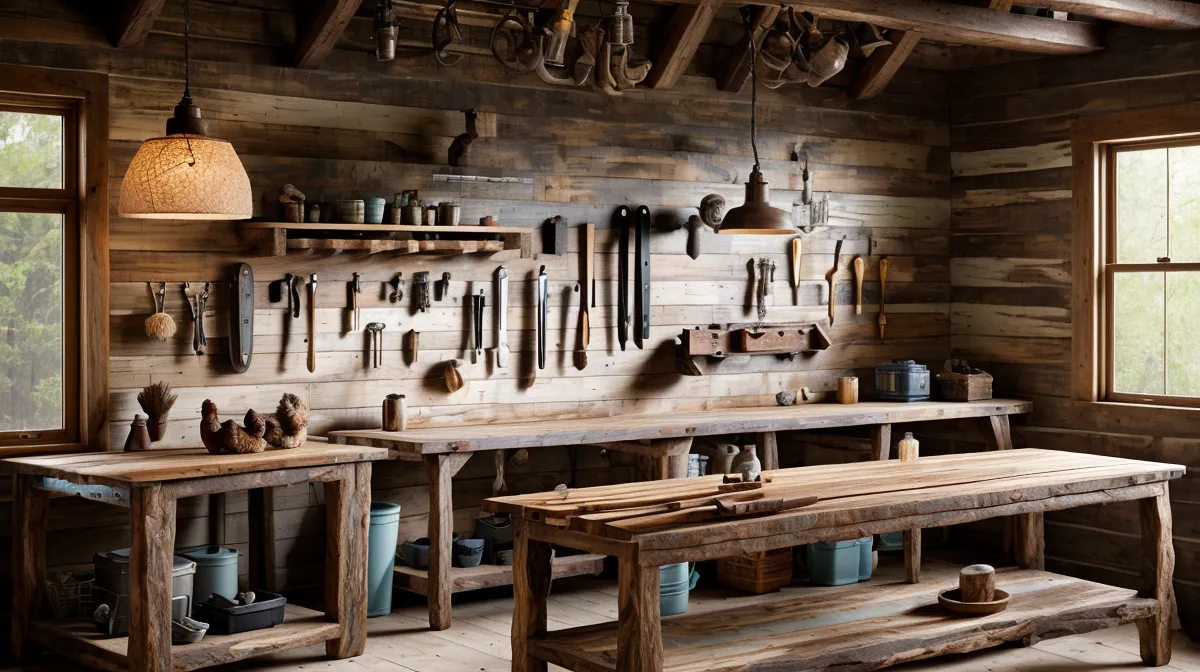
My workbench — eight feet of construction two-by-fours I framed up along the back wall a while back, top scarred with pencil marks and old glue drips — is where I do most of my layout before anything touches the floor. That's where the base rails first got squared with a framing square, and everything read fine right up until I set the assembly down flat.
The garage floor slopes slightly toward the door, which is great for draining meltwater through a Minnesota winter and terrible for building anything square. The level bubble kept drifting off-center on a frame I'd already squared on the bench, which meant the floor, not my joinery, was the thing lying to me. No matter how many woodworking videos you've watched, a sloped slab finds you eventually.
None of this was helped by the fact that I still don't run any real dust collection in an attached garage, so by the time I'd shimmed the low corners and re-squared the frame, most of an afternoon was gone in a haze of cedar dust I should have been pulling out through a vent instead of breathing. Framing here is plain butt joints and pocket screws, nothing fancy — if you want the longer version of how I chase down joinery problems once they show up, I already wrote about debugging my joinery and fixing common woodworking mistakes after a rougher project.
By week four the base carcass finally passed its own test. I set it down for a dry fit with no clamps, and all four corners sat flat against the concrete at the same time — first time that had happened on this build, and the first moment I actually believed the thing would end up square. The run frame underneath is screwed together rather than glued, for the same wood-movement reasons that kept me from gluing every joint on a dining table build a while back — screws mean I can take the whole run apart if the city ever changes its mind about backyard hens.
Should the Run Be Fixed or Mobile?
Most of the plans I looked at build a stationary coop with a fixed run, and in a subdivision that's asking for a mud pit under one patch of grass and an awkward conversation with the guy next door about smell. I went the other way and built the whole thing bottomless and mobile — a chicken tractor you drag to fresh lawn every few days, so the manure spreads out as fertilizer instead of piling up in one spot. It's closer to spreading load across a few servers than hammering one box until it falls over, and it's the single decision that's done the most for keeping this neighbor-friendly.
Going mobile also meant I skated past the whole foundation question that trips people up on anything stationary — no footings, no gravel pad, nothing permanent enough to need a permit.
Predator-Proofing Without Overbuilding
Quarter-inch hardware cloth covers the lower two feet of the run, not the flimsy chicken wire a determined raccoon treats like wet paper. I found a good roll of it secondhand at Ax Man Surplus in St. Paul, of all places, tucked between old surplus bins nobody had picked through in a while. It's miserable to cut — my palms had little wire-poke marks on them for a week afterward — but it's the only material that let me stop worrying about foxes at two in the morning.
A friend of mine, the one who spends his weekends brewing all-grain IPAs in his basement instead of standing at a table saw, looked at the run and asked why I hadn't just bought a coop kit. I didn't have a great answer beyond wanting to build it myself, which is roughly the same reason he doesn't buy his beer at the liquor store. My own tool situation is nowhere near that organized, for what it's worth — everything hangs on a pegboard by the garage door, sorted by whatever I used last rather than any real system, which is a different project entirely from the french-cleat wall I keep telling myself I'll build.
The Finish That Wouldn't Dry
Here's the thing that didn't work: I finished the exterior with an oil-based polyurethane in January, in an unheated garage, because I wanted something durable on before the ground thawed. It stayed tacky for nine straight days. I'd walk past with a clamp-on LED aimed at the vise, press a knuckle into a rail just to check, and every single time it was still soft enough to leave a print.
Cold-cure oil finishes need warmth to flash off properly, and an uninsulated garage in a Minnesota winter — where the wall on the north side doesn't climb much past 40 degrees from November through March — is about the worst environment you could pick for one. It's a finishing-process mistake I've made in different forms before, and it belongs with the rest of my coffee-table screwups more than it needs a full retelling here. Working wood in a cold garage has its own rulebook — clamp time, glue cure, finish flash-off, all of it slows down or stalls outright — and I've laid out the fuller version of those rules somewhere else.
Sanding took a few weekends after that, then paint to match the house trim rather than leave bare cedar, since a rough edge reads as an invitation for a note left on the mailbox in this neighborhood — paint built to survive a full Minnesota winter without chalking by the following fall.
What Did Six Hens and One Egg Actually Cost?
When the hens finally moved in, the neighbors didn't complain. If anything they were curious, mostly because a unit that walks itself across the lawn every few days doesn't read as a permanent structure the way a fixed coop would.
A few weeks later I walked out early and found the first egg sitting in the nesting box, still warm. Between the cedar, the hardware cloth, and eight months of garage time, it was without question the most expensive egg I've eaten, though I couldn't put a real number on it without depressing myself. If you're already staring at your own yard wondering what to build next, I went through a version of this same neighbor-friendly logic writing about why I built my own raised garden beds this spring — same rules, different vegetable.
The lesson that actually carries into the next project has nothing to do with chickens: check the floor before you trust the wood, on every build, no matter how flat the slab looks from standing height. Everything else here — the joinery, the finish, the run — I could fix after the fact. The floor is the one thing you have to get right before you start, and it's usually the thing nobody thinks to check.