A cut list either has every dimension nailed down before the first board gets ripped, or it doesn't — there's no filling in the blanks later and still landing on your numbers. That's become the whole logic behind my garage workflow: every new woodworking project gets run as either a waterfall build or an agile one, the same split I use for project management at my IT day job, and the call decides how I plan a piece of diy furniture long before a saw gets involved.
Quick disclosure before any of that: a couple of links below go to plan libraries I'm an affiliate for, and buying through one earns me a commission at no extra cost to you. I only link resources I've actually used on a real build, never a guess at what might work.
Two Ways to Run a Garage Workflow
My execution doesn't always match the framework — plenty of my early pieces still leave me wondering why my joinery looks like it was done by a caffeinated squirrel, and no amount of sprint planning fixes bad chisel technique. The split between the two approaches holds up regardless of how clean the joints turn out.
Waterfall, in software terms, means the whole spec gets locked before anyone writes a line of code — requirements, design, build, test, in strict sequence, with real cost attached to going back. Applied to a garage workshop, that's a project where every dimension, joint, and board foot gets decided on paper first, usually because the material doesn't forgive improvisation. White oak is a good example — stable enough to reward that kind of upfront planning on something like a dining table, where a late change means wasted hardwood instead of wasted time (picking the species itself is its own decision tree I won't rehash here).
Agile is the opposite bet: build a small piece, test it against how it actually gets used, adjust, repeat. For that side of the workflow, the toolkit is almost insultingly simple — a Kanban board made from painter's tape and sticky notes, a handful of columns, and the discipline to actually move the notes instead of taping it up and forgetting it exists.
Two people I know split this same line without ever framing it that way. Theo Buraczewski, a fellow member of my woodworking meetup, won't make a crosscut until he's traced the grain direction across the board with his thumb first — about as waterfall as this hobby gets, deciding everything before the saw even turns on. My next-door neighbor, Marcus Vanhook, runs the opposite failure mode: he'll sand a tabletop three extra passes past done because he's quietly competing with whatever I finished last, even though he'd never admit that's what's happening.
When the Full Spec Comes First
Full-spec planning earns its keep most on anything big enough that wood movement becomes a design constraint instead of a footnote — worth its own complete explanation elsewhere on the site, but the short version is that it's a call made in the design phase or not made at all. That's the reason a bigger build gets drawn out fully in advance instead of improvised at the bench.
A finished dining table is the clearest proof of that. My wife stood in the garage doorway looking at it — flat top, tight joints, nothing that screamed first attempt — and admitted, in a tone that suggested she hadn't fully expected it, that the thing actually looked like real furniture.
Blueprints do the same job on paper that a spec does in software — someone else already worked out the cut list, meaning I find out I'm three inches short on stock before I'm at the saw instead of after. I've leaned on the library at TedsWoodworking for exactly that reason on bigger pieces (it's not flawless — some of those plans assume tools I didn't own during my first year of doing this), but for a waterfall-style build it beats freehand math every time. The full breakdown of how I filter through sixteen thousand of those plans lives in my TedsWoodworking review, if the short version here isn't enough. None of it works without a bench solid enough to hold a workpiece still during layout, which is its own planning problem covered separately rather than folded in here.
Why the Bench Cubbies Prove Agile's Point
The mudroom bench by the back door is the case study for the opposite approach. Carcass built first, shelf dividers not yet closed up, I asked my wife to bring out her tallest winter boots to check the fit — and the "standard" boot height I'd measured off didn't come close to fitting an insulated Minnesota boot.
They came nowhere close.
Because nothing was final yet, the fix was moving a shelf pin and giving up one small cubby to make room for a taller one, not redoing the whole piece. That's the entire case for building agile: a cheap correction beats an accurate-looking upfront guess whenever the real requirement isn't something you can look up in advance.
What Happens When You Skip a Finishing Step?
Pine punishes shortcuts harder than oak does. I skipped conditioner on a pine project once, figuring stain was stain, and ended up with a splotchy, streaky finish that soaked in unevenly wherever the grain ran dense — more coats didn't fix it, only stripping the piece and redoing the finishing step from scratch did. That's a waterfall lesson hiding inside an agile build: a handful of steps in the sequence genuinely can't be skipped or reordered, no matter how iterative the rest of the project is. Finishing deserves its own full breakdown rather than a tangent here, but surface prep is the one phase where "ship it and fix it later" costs more than it saves.
Dust is the same trade-off in miniature. Fine walnut dust settles into a pale film across the black casing of a cordless drill in less time than it takes to swap bits, which is reason enough to treat cleanup as part of the build sequence instead of an afterthought bolted on at the end.
Cold makes all of it slower to cure and less forgiving of shortcuts, which is its own planning headache — there's a full Minnesota Winter Survival Guide for Unheated Garage Woodshops on the site for anyone dealing with that on top of everything else.
Does Agile Woodworking Work Without a Garage?
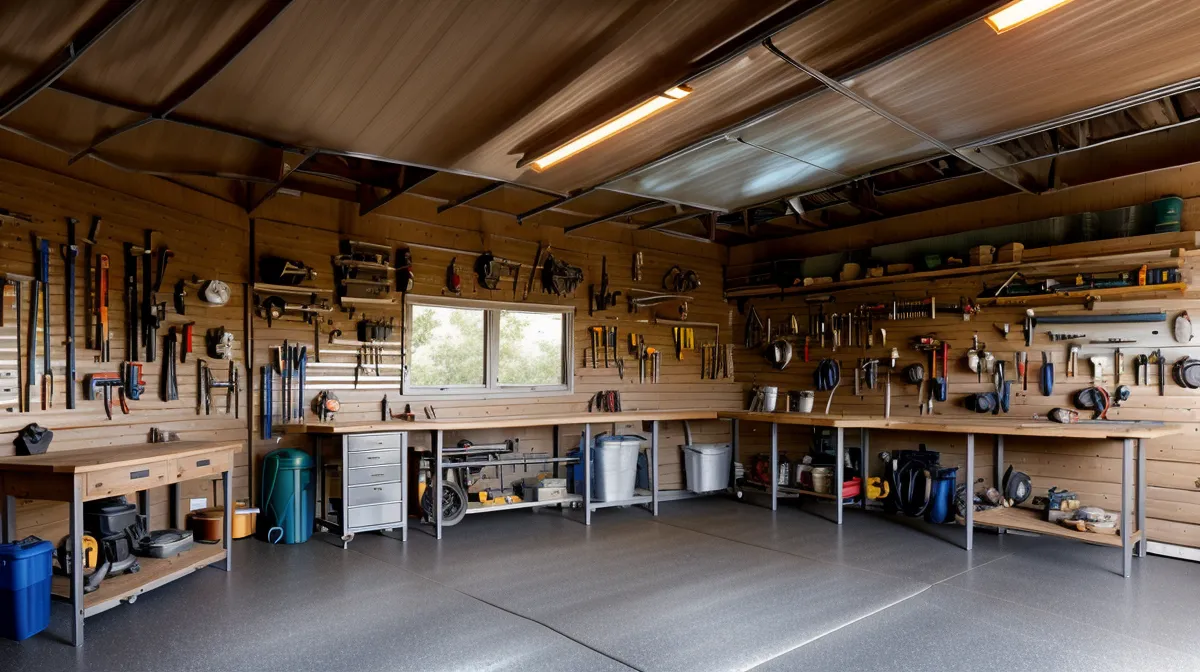
Agile-style building assumes work-in-progress can just sit there between sessions — a glued-up carcass on the bench, a labeled pile of cut parts, the Kanban tape still stuck to the wall from last weekend. Anyone working out of an apartment or a shared garage loses that advantage immediately, because breaking the whole setup down and re-establishing where a project stands every single session is overhead on top of the actual building.
Storage systems can close some of that gap. Wall-mounted cleat systems in particular let a whole shop get broken down and rehung in minutes instead of boxed up piece by piece, though starting from a Module_root__BamsY table in a spare room still usually favors a full-spec plan followed start to finish without needing to remember where things were left off.
Choosing the Right Approach for Your Next Build
None of this means picking a permanent side and sticking to it. Full-spec waterfall planning is the right call when the material is expensive, the joinery is unforgiving, or the piece has to fit an exact space — a dining table, a built-in, anything where a mid-project pivot wastes stock instead of just time. Agile-style iteration is the right call when the real requirement can't be known in advance, like the exact height of somebody's winter boots, or when the project is small enough that a wrong turn costs an hour instead of a slab of hardwood.
It's the same logic as picking a cross-country ski route through Theodore Wirth Park — some days the whole loop gets mapped before anyone clips in, other days it's just a direction and the willingness to adjust once boots are on snow, and both get you through the afternoon just fine. Woodworking plans work the same way.
If the next build leans full-spec, a solid library like TedsWoodworking is worth reading through before touching a board — it's saved more than one "three inches short on stock" surprise on the projects where that actually mattered. If it leans agile instead, keep the plan loose, keep the shelf pins adjustable, and don't mistake flexible for unplanned — there's still a backlog, it just gets reordered more often than a waterfall one does.