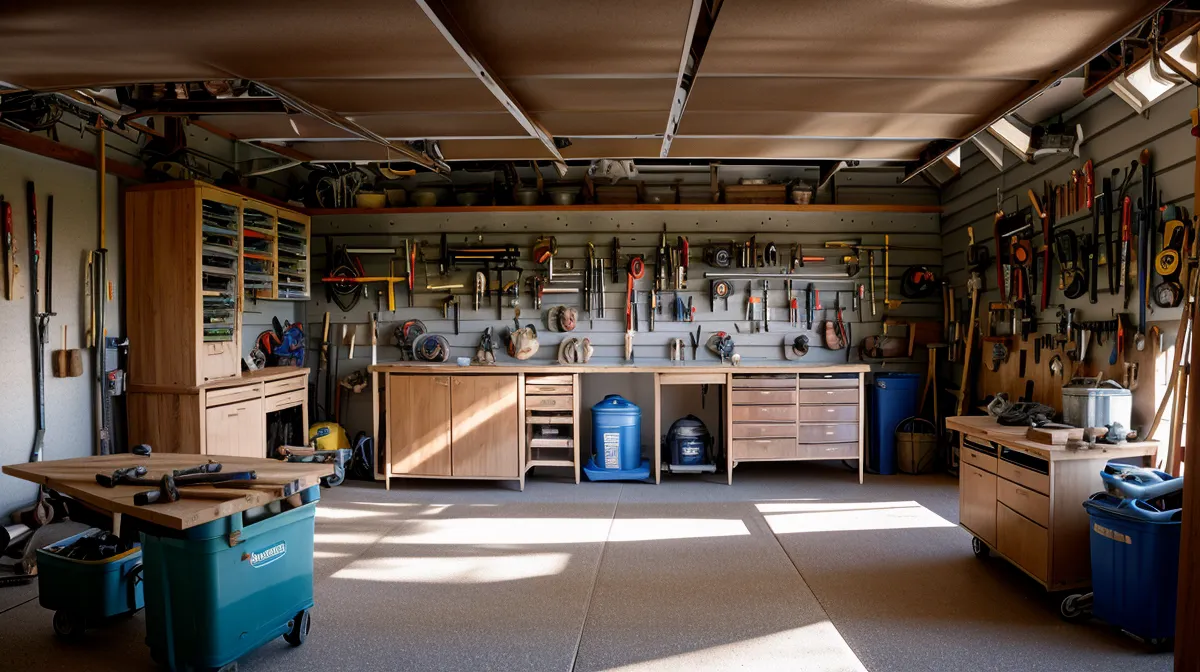
What's the better fix for a two-car garage that's already lost half its floor to tools: bolt storage to the wall, or put it on wheels? That question ate up most of a cold Minnesota stretch before I ever touched a board. Between the miter saw, the drill press, and a lunchbox planer heavy enough to throw my back out, my side of the garage had turned into an obstacle course, the kind of clutter that turns a weekend project into a hazard instead of a hobby. This is the case for and against building a mobile tool cart, one of the more forgiving woodworking plans I've tried, and why garage organization in a shared two-car space usually comes down to a trade-off nobody spells out clearly.
Wall-Mounted Storage or a Rolling Cart: The Real Garage Organization Question
Every forum thread about small-shop storage eventually splits into two camps. One says build a fixed wall system and never move it again. The other says put everything on wheels so the floor plan can change with whatever project is on the bench that week. I looked hard at the wall option first, mostly because a cleat-and-hook wall looks so tidy in photos people post online. Storage here turned out to be about mobility instead of the wall; a cart that rolls out of the way when the car comes home solves the real constraint in a shared garage, which a fixed wall system never really addresses.
The plan itself called for straightforward plywood construction, so I picked up a single sheet of maple ply from a big-box store instead of hunting down anything fancier. Maple wasn't the only option sitting on that rack — birch and construction-grade fir were right next to it — but for something that would take daily abuse from tool weight, workability tipped the decision toward maple. I still checked face grain direction on every cut before loading a panel onto the cart, a habit that matters just as much on shop furniture as it does on anything meant to sit on a kitchen counter.
The Case Against the All-In-One Station
Most of the mobile workbench plans I found online looked like aircraft carriers — heavy, full-sized stations built to do everything at once. They're impressive, and completely wrong for a guy who shares floor space with a snowblower and a bag of ice melt. Building one of those would have created its own permanent obstacle, which defeats the entire point of a small-garage build. So I went looking for something narrower and lighter instead, willing to trade capability for the ability to actually push the thing into a corner. I applied what I've called Agile Woodworking to the decision: small modular pieces instead of one big design — which is mostly an excuse to borrow language from my day job for something that's really just common sense.
This cart was never meant to replace a proper fixed workbench setup — that's its own project with its own list of decisions — it just needed to hold whatever tool doesn't have a permanent spot yet. Some lessons carried over from other builds anyway, even though this one wasn't furniture. A white oak dining table I built taught me that wood movement is a completely different problem than anything sheet plywood has to deal with, since solid boards shift with the seasons in a way a cart's panels just don't, so I didn't worry about it here. That table is also the piece my wife walked past one evening, stopped in front of, and admitted actually looked like real furniture instead of a garage experiment, which was a bigger compliment than she probably meant to hand out.
Routing a Dado Without a Fence Was a Bad Shortcut
The shelves inside the cart needed dadoes to keep them from racking under a tool's weight, and clamping down a fence for something that short seemed like overkill. Freehand, following the pencil line, should have been close enough. It wasn't. The router bit wandered right at the exit point and blew out a chunk of the front edge, leaving a ragged notch instead of a clean shoulder. Dadoes are just one of several joinery types, and all of them only hold up if the layout stays exact — skipping the one setup step that guarantees that turned into a shortcut that cost more time than it saved.
A cheap edge-guide attachment I'd bought for the router was part of the problem too. It flexed under any real pressure instead of holding a straight line, which is probably why freehand felt like a reasonable idea that morning. Cold didn't help either — this happened during a stretch cold enough that glue takes noticeably longer to grab in an unheated garage, and patience runs thinner than usual when your hands are stiff. I ended up flipping the damaged panel so the ragged edge faced the inside of the cart, hidden once the drawer slid in front of it, a fix that only worked because the mistake happened somewhere I could still hide it.
Casters, Plywood, and a Lumber Price Check from Ray
Four heavy-duty casters went on the base, rated well past anything the cart would ever actually carry. That's the same instinct I bring home from IT — if a system needs to handle a modest load, you spec it for several times that so you're not troubleshooting a failure at the worst possible moment. Dust management is its own ongoing project in this garage, mostly separate from this build, but the bottom shelf still needed to sit high enough off the floor for the shop vac hose to reach under it without rerouting anything.
Ray Ambrosio, a colleague from work who picked up furniture refinishing as his own weekend habit, stopped by while the maple sheet was still leaned against the garage door and glanced at the price tag out of habit. He tracks lumber prices across three different yards in a spreadsheet he still shares with half the office, and told me I hadn't overpaid, which from him counts as a review. Budgeting a garage shop rarely gets talked about in real numbers, and this isn't the place to start, but the honest version is that a cart like this costs less than most people assume once you stop buying a full sheet of plywood for every single panel.
Fine dust — walnut, going by the color, left over from some earlier project — had already worked its way into the black casing of my cordless drill by the time I got around to labeling the cart's shelves. Small detail, but it's the kind of thing that tells you how long a tool has actually been sitting out instead of put away.
Why a 16,000-Plan Library Works as a Baseline
The actual cart design came out of a plan library I'd already been using for other builds, one that claims something like 16,000 plans in its catalog. Whether a library that size is worth paying for is a separate question from whether any single plan inside it is any good, and plenty of people spend more time reviewing the login process than the actual cut list. For me it's less about following instructions to the letter and more about having a reference architecture to start from. I rarely build exactly what's on the page, but the structural logic underneath usually holds up well enough that I'm not guessing at joint placement from scratch.
Quality varies wildly across a library that big, and this particular design held up fine under an actual tool load once it was finished, which isn't something you can judge from a rendering on a screen.
The Cart Earned Its Spot in the Corner
Final coat of finish went on around the time the groomers were laying fresh corduroy on the ski trails at Theodore Wirth Park, once the weather cooperated enough to crack the garage door for ventilation. Finishing is its own topic that deserves an honest accounting somewhere else, but bare plywood in a humid garage doesn't hold up over a full season, so a topcoat isn't optional even on utility furniture. Glue got a full day to cure before any tool touched the shelves, which is about the only patience I consistently manage in this hobby.
Rolling the finished cart across the floor for the first time, locking the casters, and finding a tool in under five seconds instead of moving three bins to get to it — that's the whole argument for wheels over walls, settled in one afternoon. It tucks into a gap near the water heater when it's not in use and rolls back out in about the time it takes to open the garage door.
Leftover offcuts from a build like this shouldn't just pile up in a corner either. I wrote separately about turning scrap into fast wins in The 4-Hour Gift: 5 Quick Woodworking Projects Using Only Scrap Wood, which is a better use of a free afternoon than letting the bin grow until someone trips over it.
So which one actually wins, the wall or the wheels? If your garage never loses the car to weather or a second vehicle, bolt the storage to the wall and be done with it — it's simpler, and it won't roll into anything overnight. If your floor plan changes week to week, or the car needs the space back every single evening, put wheels under the tools instead. Mine does now, and the argument that started this whole build is finally settled.