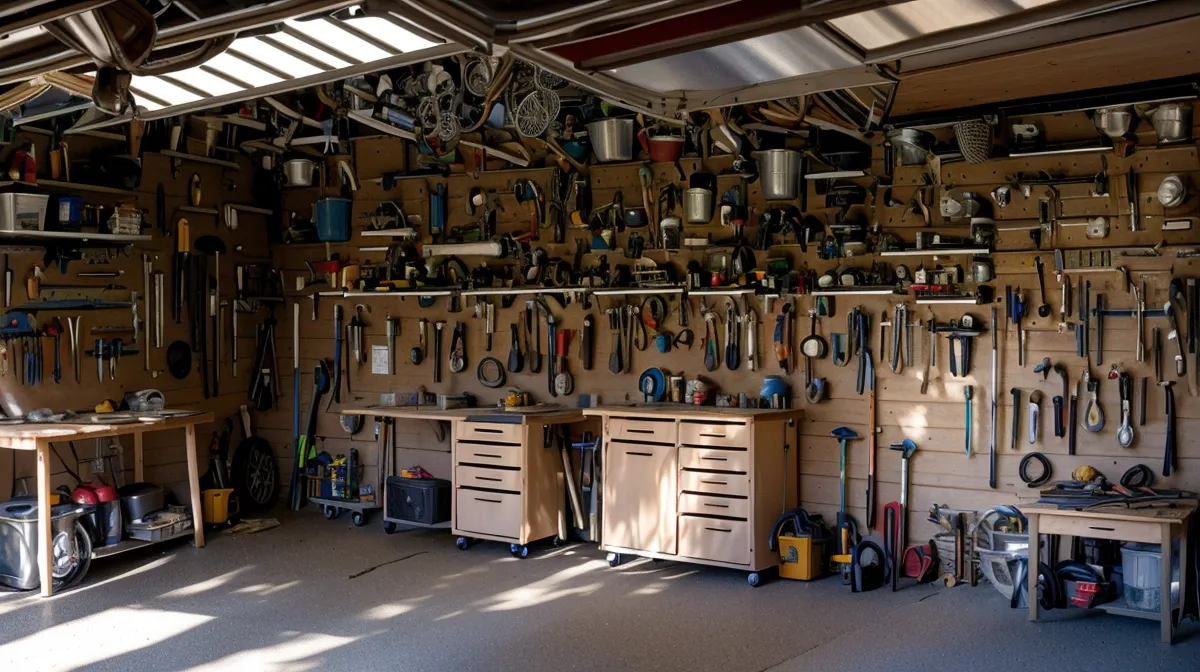
Blow your nose after an hour of sanding walnut trim and take a look at the tissue — that's roughly what convinced me my garage workshop needed a real dust collection system instead of an open door and good intentions. Treating sawdust as background mess is a shop safety problem hiding behind a chore, and most advice assumes fixing it costs more than a budget-minded woodworker has to spend.
Two zones, in my head: a clean side of the garage where the mower and my wife's SUV live, and a sawdust side that's mine. I'd assumed the line held on its own, the way a subnet holds until someone screws up the routing. It doesn't. Fine dust ignores boundaries and settles on the water heater, the holiday bins, and eventually your lungs, whether you drew a line on the floor or not.
Why Sawdust Is a Bigger Problem Than It Looks
Wood dust carries a Group 1 carcinogen classification, which puts it in a category most people associate with far scarier materials — not because a little sawdust on your hands is dangerous, but because of what stays suspended in the air long after the cut is finished. None of this has to do with grain direction or which way you feed a board through the planer — that's a separate skill with its own article — this is strictly about what happens to the byproduct once it's airborne.
Shop safety conversations tend to focus on blade guards and push sticks, which matter, but the stuff you can't see running through the air is the slower threat, and it's the one most budget-conscious hobbyists ignore until something forces the issue.
What Does a Budget Dust Collection System Actually Cost?
A setup built around a shop vacuum, a cyclonic lid, some PVC, and a box fan runs about $275 total: roughly $120 for a 12-gallon high-suction vacuum, $45 for the cyclonic separator that keeps debris from clogging the filter, $65 for pipe, a bucket, and hose clamps, and another $45 for a box fan and a MERV 13 furnace filter to scrub the air afterward. Compare that to an entry-level professional wall-mount system, which was hovering around $1250 before factoring in the electrical upgrades most garages need to run one, and the DIY route saves $975 — money better spent on hardwood than on ductwork.
Everything on that list came from one trip to the Menards on American Blvd in Bloomington — vacuum, fittings, and filter, same cart, same register, no ordering industrial equipment and waiting on a freight truck.
I've broken down total workshop cost budgeting elsewhere, covering everything from the table saw to the shelving, and dust collection is usually the line item people skip first because it doesn't produce anything you can point to when the project is done. That's the opposite lesson from the one I learned buying a Harbor Freight workbench kit instead of just building a proper one from the start — cheaper up front, more expensive over time once you count the hours spent fighting a wobbly top. Dust collection is the rare corner of a shop budget where going cheap is actually the smart move, because the $1250 unit and the $275 one are doing the same basic job: moving air and trapping particles.
A friend of mine spends most fall weekends hunting whitetail deer on a family parcel up near Brainerd, and when I told him what the whole setup cost, he pointed out it was less than what he spends on gas for one trip north. Perspective helps when you're staring at a receipt for shop vac parts.
Routing the Pipe Without Killing the Suction
Running PVC through a two-car garage without blocking the door track is a plumbing puzzle more than a woodworking one. Every 90-degree bend costs you airflow, the same way a slow hop between routers adds latency to a network — so I used 45-degree elbows everywhere the layout allowed, and let the pipe take a longer path rather than a sharper turn.
This isn't wood joinery — no dovetails or mortise-and-tenon joints to fuss over, just primer and cement — but a loose PVC joint fails exactly like a loose wood joint does, just louder about it. My first 5-gallon bucket answered that question for me: I hooked the vacuum up, switched it on, and the thin plastic collapsed in on itself the instant real suction hit it. A reinforced bucket from the same Menards run fixed it, but the sound of that first bucket imploding is not one I want to hear twice.
A tea-kettle whistle from one of the joints took longer to track down. Turned out a gap barely visible to the eye will scream once air is moving through it at speed, and a bead of silicone around the joint killed the noise for good. Leaks like that don't just cost you sound — they cost you the suction you're paying for at the far end of the line.
The Air You Can't See Is the Real Problem
Most advice aimed at hobbyist shops points you toward a bigger cyclone separator, on the theory that if the chips are handled, the dust problem is solved. Chips are a nuisance. The real hazard is particulate matter under 2.5 microns, which is smaller than what a standard shop vac filter is built to catch — most only stop particles down to 5 or 10 microns, so the dangerous fraction goes straight through and back into the air you're standing in.
A box fan taped to a MERV 13 furnace filter, running the whole time you're cutting and for a while after, does more for actual air quality than any cyclone attachment. Wood species selection matters here too — that's really a separate topic about picking the right board for a project, not about cleanup — but dust behavior does vary by species, and the clearest proof of the filter working showed up on a walnut end-grain cutting board I'd just glued up and flipped over. The checkerboard pattern came out glossy, with none of the fine grit that used to work its way into a still-tacky finish before this setup was running.
I've applied this same minimum-effective-system thinking elsewhere in the shop, too — Agile Woodworking: Applying IT Project Management to My Garage Workflow gets into how that mindset changed the way I plan builds generally, not just dust control.
Finishing has its own dust problem, separate from this one — sanding between coats of poly throws just as much fine material as the initial shaping does, which is its own process worth covering on its own instead of folding into a piece about dust collection.
Two Ways to Wreck It After You've Built It
The cyclonic lid handles roughly 99% of debris before it ever reaches the vacuum, dropping it straight into the bucket, which makes it easy to stop checking the bucket level. Skip that check long enough and the overflow finds the vacuum's own filter instead, which is a slower, more expensive way to clean up the same mess. Emptying the bucket before every session is the entire fix — no upgrade required, just a habit.
Where the vacuum and hose live between projects is really a shop storage question, not a dust question, and it's worth solving with a proper wall-mounted system rather than leaving everything coiled on the floor where it collects dust from the last session.
None of this came out of a downloadable plan set, either — dust collection is infrastructure, not a project with a cut list, so evaluating whether a set of plans is worth paying for is a completely different exercise than anything covered here.
Minnesota winters complicate the picture further. A garage sealed tight against the cold holds dust in the air longer than one with a door cracked open, which means the fan-and-filter combination has to run longer to clear the same room — one more trade-off specific to cold-weather shop time that's worth its own separate look.
Wood movement is a completely different headache from any of this — one is about a board changing shape with the seasons, the other is about what's floating in the air while you cut it — but people tend to lump every shop problem into the same bucket. If your shop lives in a standalone shed or other outbuilding rather than an attached garage, the ductwork and even the foundation questions change enough that it deserves separate treatment instead of a few lines here.
Testing Whether It Actually Works
The real test is simple: run a full day of milling and sanding, then wipe a white cloth across a surface ten feet from the saw — the top of a water heater works well, since it usually collects a season's worth of grime unnoticed. A clean cloth after a full day means the system is doing its job; dust on the cloth means something in the setup — the piping, the filter, or the habit of emptying the bucket — needs another look.
After six years of doing this, that white-cloth test is still the metric that matters more than any dollar figure I could throw at the setup. You don't need a $1,200 industrial unit to pass it — you need airflow that actually moves the air, and the discipline to run the fan every time you cut.