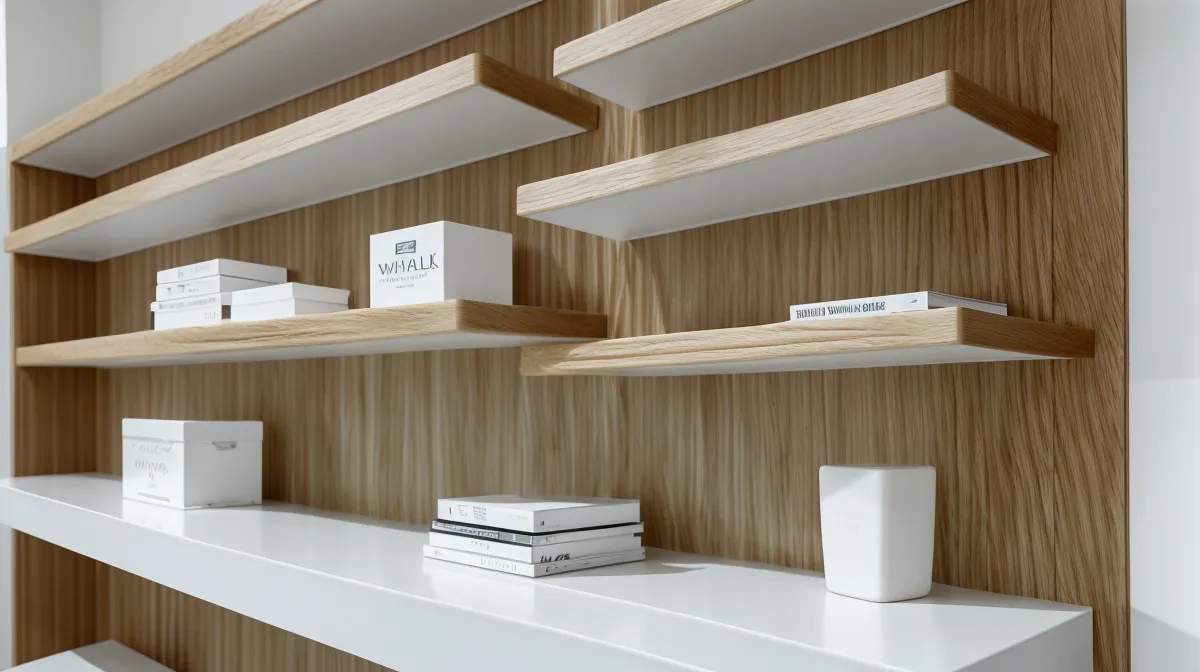
Every piece of dimensional lumber I bought for this build measured 1.5 by 3.5 inches, not the 2 by 4 stamped on the price sticker at Menards on American Blvd in Bloomington. That gap between nominal and actual lumber dimensions is the first thing that trips people up on a DIY floating shelves project, and if you don't build it into your plan, a shelf that's supposed to disappear into a modern living room wall ends up a half-inch off from what you measured on paper. My wife wanted three of them — thick, no visible brackets, nothing that looked like a wire rack from a big-box store — which meant this needed to work more like a home improvement engineering problem than a weekend furniture project.
The obvious route is a heavy-duty steel bracket bolted straight through the drywall into a stud. I went a different way: build an internal wood frame that does the structural work, then slide a finished outer sleeve over it so no hardware ever shows. Two separate jobs pretending to be one shelf — a skeleton that holds the weight, and a skin that just has to look good.
Choosing Sleeve Wood for a Modern Living Room Shelf
I used white oak for the outer sleeve, mostly for durability — on the Janka hardness scale it comes in around 1360 lbf, hard enough to shrug off a ceramic vase set down harder than intended, though a lot less forgiving to sand than the pine I used on my first-ever, distinctly lopsided bookshelf. Picking the right species for a given project is its own decision tree, and I still keep a wood species reference open in another tab rather than trusting memory. Grain direction matters here too, more than I appreciated early on — the first time it really clicked was flipping a walnut end-grain cutting board out of the clamps and watching the checkerboard pattern catch the light like glass, a completely different project, but the same habit of reading the wood before committing to a cut. White oak also moves less across the seasons than a softer species, though wood movement is its own deep enough subject that it deserves a dedicated breakdown rather than a paragraph tacked onto a shelf project. Mitering the sleeve's corners tight enough to hide the plywood core underneath is its own joinery call, too, and a different one than I'd make on a piece that needs to survive getting knocked around — longer conversation than fits here.
Skip the Toggle Bolts — Use a French Cleat Instead
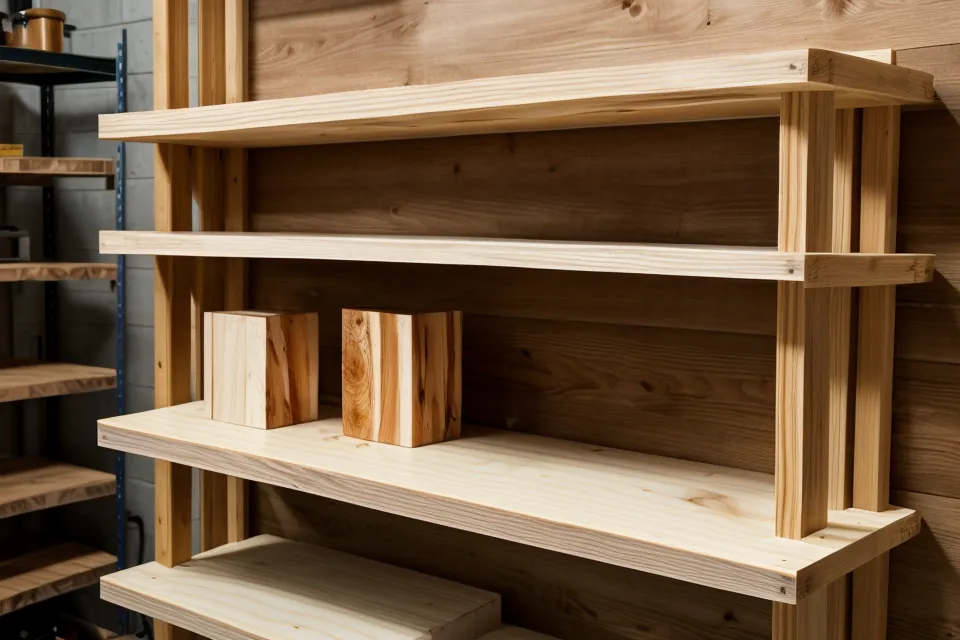
Most tutorials point you toward rated wall anchors or toggle bolts for a shelf this size. I'd skip them. Drywall is compressed paper and gypsum — it holds a picture frame fine, but a shelf ten inches deep pulling outward puts leverage on that anchor it was never built for, and even the ones rated for real weight tend to sag eventually. A French cleat mounted straight into the studs solves it differently: you're not asking the wall to hold the shelf, you're asking the house's actual frame to hold it. Standard stud spacing in a US home runs 16 inches on center, so I ran a stud finder across the wall, marked three studs, and screwed a beveled 2x4 directly into all three before the internal frame ever went near it. If a shelf can catch three studs instead of one, use all three — that's the rule I'd give anyone building this. French cleats aren't just for shelves, either; I've used the same idea to hang tool storage along one wall of the garage, though that's a different set of measurements and a different project entirely.
Why a Real Woodworking Plan Beats a Paused YouTube Video
My first attempt at this build started from a YouTube video, and I made the mistake of working straight off the paused frames instead of tracking down the actual dimensioned cut list the video was based on. That's how I ended up cutting a top panel a quarter inch short — I'd forgotten to account for the saw's kerf, the sliver of material the blade itself removes with every pass, usually around an eighth of an inch. Four cuts, four kerfs, and I was half an inch short of where I thought I'd land. It's the woodworking version of ignoring a rounding error until it compounds: harmless once, expensive by the fourth pass. That gap between a real dimensioned plan and a video you're pausing and eyeballing is exactly what separates a usable set of plans from a stack of vague ones, and it's worth checking before you buy lumber, not after. None of this works either without a bench solid enough to clamp against without the whole assembly racking sideways — worth sorting out before a project like this, not during it.
Even people who start from a solid plan aren't immune to this. My wife's book club friend Darlene Kowalczyk asked me to build something similar after seeing this project, then texted me four extra inches of depth once she was already partway through her own cut list — the kind of mid-build spec change that wrecks a plan if you don't redo the math before the saw comes back out.

How Do You Scribe a Shelf to a Wall That Isn't Flat?
Once the sleeves were mitered, glued, and sanded, I brought them into the living room and found an eighth-inch gap between the back edge and the wall in more than one spot — our walls have enough waviness that a flat board just won't sit flush against them. Scribing fixes that: hold the piece in place, run a compass along the wall so one leg traces the surface and the other marks a matching line on the wood, then sand or shave down to that line until the back edge mirrors the wall's own contour instead of fighting it. It's slow, and it's the kind of detail work that punishes impatience. If that sounds like more precision than you want for a first project, a beginner-friendly picnic table plan is a better place to start — a gap that size just reads as character on an outdoor table, not a flaw.
Mounting the Frame and Finishing the Sleeve
Sanding oak from 80-grit up through 220 throws noticeably more dust than pine does, and without some kind of collection running, you end up wiping a film off every flat surface nearby before you're done. Dust management is worth solving on its own terms rather than as an afterthought here. Glue cure time also stretches out once the garage gets colder — cold-weather woodworking is its own scheduling headache I plan around rather than fight. Steel brackets would have gone in faster, but they add up fast once you're buying enough of them for three shelves, and running the actual numbers on what a garage shop costs to keep stocked is a bigger conversation than one shelf project can hold. Once the internal frames were screwed into the studs, the sleeves slid over them and sat flush, with no fasteners visible anywhere. I finished the oak with a simple matte polyurethane instead of anything glossy, since anything shinier would have fought the minimalist look. A reader named Priya Sundaram emailed me after a cutting board post asking whether that kind of finish was food-safe, which is exactly the right question for a cutting board and mostly beside the point up here — nothing on a living room shelf touches food, so the finish just needs to hold up and stay flat.
The shelves have held steady since, vases and all, and the two things worth getting right before you start are the same two that show up on almost any built-in: get the mounting into real structure instead of trusting the wall on its own, and build the kerf and cut-list math into your numbers before the saw ever turns on. Everything else — the miters, the scribing, the finish coat — is detail work you can fix as you go. If you want to see where a similar build went sideways in more places than this one did, I've written up what went wrong building a DIY modern coffee table in more detail.