I ripped a chunk out of a red oak breadboard project because I grabbed the hardness number off one of those laminated wood-comparison charts you can buy at the woodworking show for about twelve bucks — the number on it was closer to white oak, and red oak fought me on every single pass with the spindle sander. That chart's job now is holding down a paint can in the garage. This page is the fix I built for myself: Janka hardness, grain, and workability notes for the species I actually reach for, pulled straight from the source instead of a poster that apparently rounds numbers to whatever looks tidy on a shelf.
I'm not a carpenter — I'm an IT project manager who built a deeply lopsided bookshelf during COVID and never really stopped. Half my garage is a shop now (my wife negotiated hard for the other half), and I've since built everything from cutting boards to a dining table she'll actually let guests sit at. I think of this table the same way I think of a good runbook at work: I don't want marketing copy or vibes, I want the number, where it came from, and whether the wood is going to burn my planer blade or glue up without a fight. Measure twice, check the source once — that's basically my whole system now.
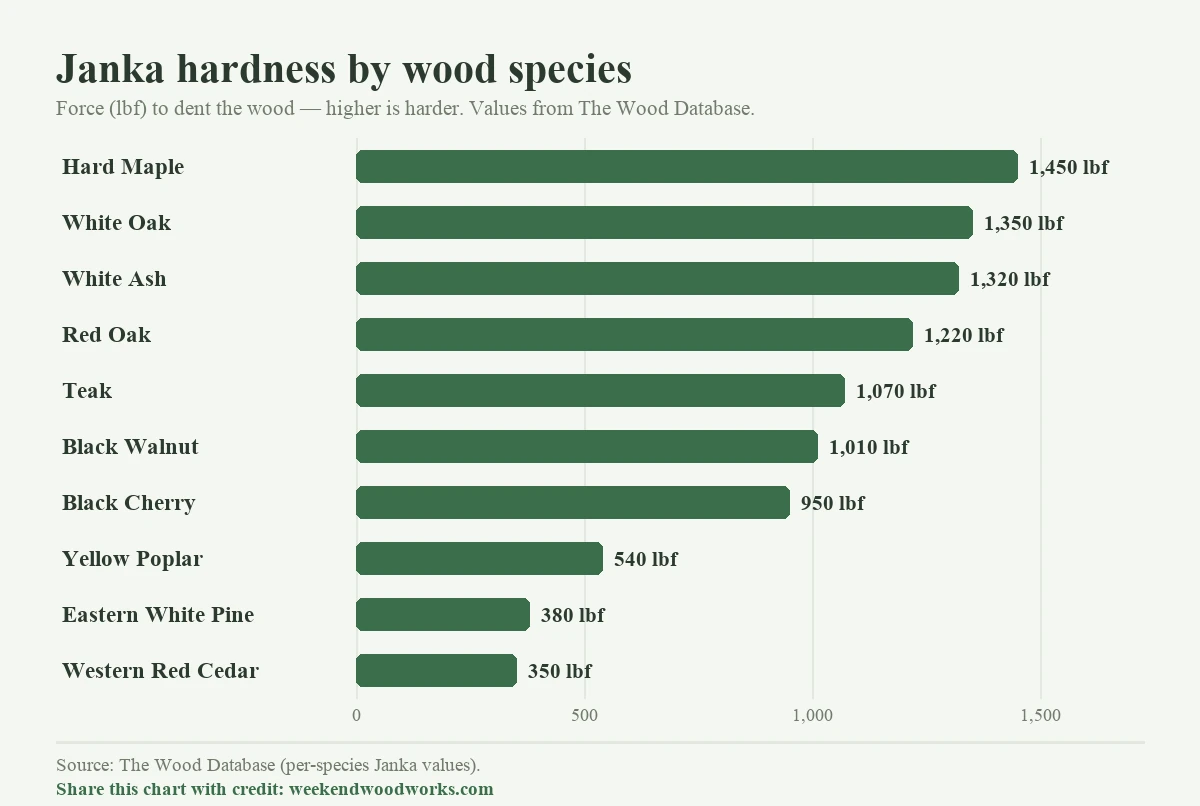
The catch: hardness isn't the whole story — hard maple (1,450 lbf) can burn under dull tools, teak's silica blunts your blades despite a moderate 1,070, and soft western red cedar (350) is brittle and splits; workability matters as much as the Janka number.
Wood Species Comparison Table
| Species | Janka Hardness (lbf) | Grain Type | Workability Notes |
|---|---|---|---|
| Black Walnut (Juglans nigra) | 1,010 lbf (Wood Database) | Straight; occasionally wavy | Responds well to steam bending; glues and finishes excellently. |
| White Oak (Quercus alba) | 1,350 lbf (Wood Database) | Straight; coarse/uneven | High shrinkage rate; requires pre-drilling. Exceptional rot resistance. |
| Hard Maple (Acer saccharum) | 1,450 lbf (Wood Database) | Closed; fine/uniform | High density can cause tool burning; turns and glues well. |
| Black Cherry (Prunus serotina) | 950 lbf (Wood Database) | Fine; closed/straight | Easy to machine; susceptible to blotching when stained. |
| Red Oak (Quercus rubra) | 1,220 lbf (Wood Database) | Open; coarse | Easy to work with machine tools; open pores require filler for smooth finish. |
| White Ash (Fraxinus americana) | 1,320 lbf (Wood Database) | Straight; coarse | High shock resistance; responds well to steam bending. |
| Yellow Poplar (Liriodendron tulipifera) | 540 lbf (Wood Database) | Straight; uniform | Soft and easy to machine; can leave "fuzzy" surfaces if tools are dull. |
| Eastern White Pine (Pinus strobus) | 380 lbf (Wood Database) | Straight; even | Extremely easy to work with hand tools; prone to indentation. |
| Western Red Cedar (Thuja plicata) | 350 lbf (Wood Database) | Straight | Very soft and brittle; excellent natural resistance to decay. |
| Teak (Tectona grandis) | 1,070 lbf (Wood Database) | Straight; occasionally wavy | High silica content causes significant blunting of cutting edges. |
The terms below trip people up more than the numbers do — I definitely mixed up open grain and closed grain out loud in front of a Rockler employee once, so here's the cheat sheet I wish someone had handed me that day.
Glossary of Technical Terms
- Janka Hardness
- The industry-standard measurement of how much a wood resists denting and wear — the force (in lbf) required to embed a .444 in (11.28 mm) diameter steel ball into the wood to half the ball's diameter (Wood Database). Higher number, harder wood, more resistance when you're planing or drilling it.
- Open Grain
- Wood with large longitudinal cells (vessels) that show up as visible pits or grooves on the surface — Oak and Ash are the classic examples. These are the boards that'll drink grain filler like it's on sale if you want a glass-smooth finish.
- Closed Grain
- Wood with pores too small to see with the naked eye, which is why Maple and Cherry come out of the finishing process looking smoother with a lot less effort on your part.
- Workability
- How easily a species cuts, shapes, and finishes with hand or machine tools without chipping, burning, or eating your blades. It's qualitative, not a number on a spec sheet — mostly it means "how much is this board going to make me regret my choices today."
- Specific Gravity
- The ratio of the wood's density to the density of water (Wood Database) — useful for estimating how heavy and how strong a piece is going to be before you haul it out to the truck.
Last verified: 2026-07-11
Sources
- The Wood Database: Black Walnut (Juglans nigra)
- The Wood Database: White Oak (Quercus alba)
- The Wood Database: Hard Maple (Acer saccharum)
- The Wood Database: Black Cherry (Prunus serotina)
- The Wood Database: Red Oak (Quercus rubra)
- The Wood Database: White Ash (Fraxinus americana)
- The Wood Database: Yellow Poplar (Liriodendron tulipifera)
- The Wood Database: Eastern White Pine (Pinus strobus)
- The Wood Database: Western Red Cedar (Thuja plicata)
- The Wood Database: Teak (Tectona grandis)
- The Wood Database: Janka Hardness (technical article)
- The Wood Database: Specific Gravity (technical article)