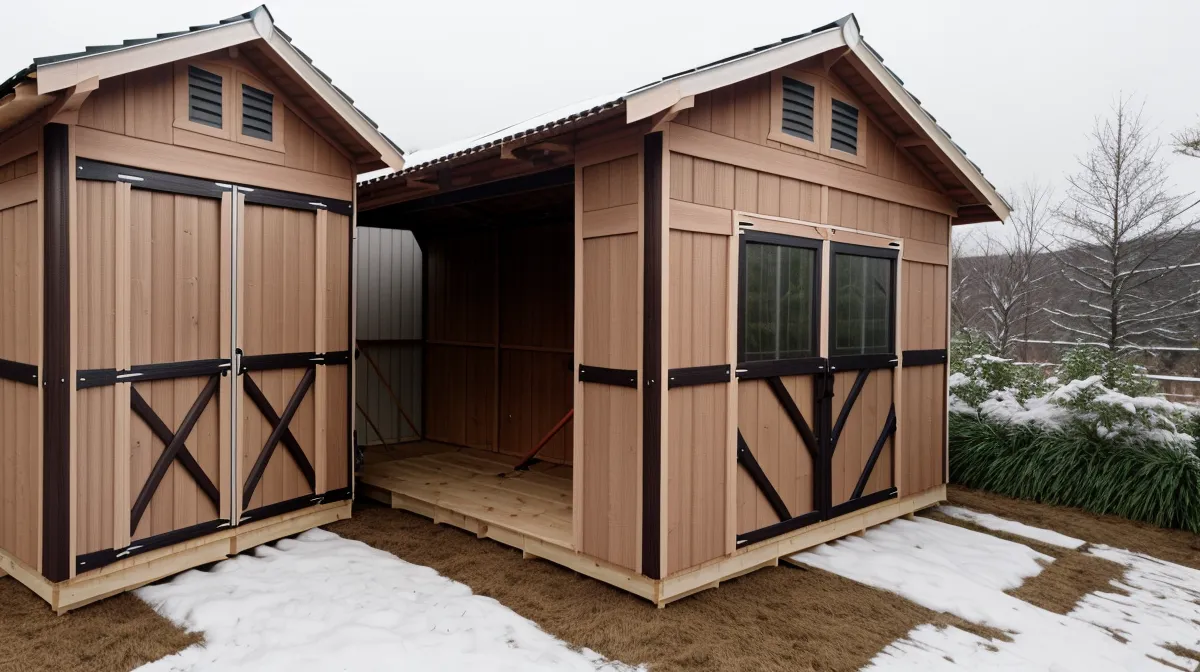
I was standing in my driveway on March 12, 2026, staring at a stack of forty-two pressure-treated 2x4s and feeling like a project manager who had just promised a Q1 delivery without checking the server capacity. The delivery guy from the local lumber yard had dropped the pile right where my wife usually parks her SUV, which meant I had exactly forty-eight hours to turn this 'technical debt' into a structure or face a very domestic performance review.
Full disclosure before we get into the sawdust: This site uses affiliate links. If you buy something through these links, I earn a commission at no extra cost to you. I only recommend plans and tools I have actually used in my own workshop—or in this case, my muddy backyard. My wife has a strict 'no junk' policy for the garage, and I apply that to my recommendations too.
The goal was simple: an 8x12 storage shed to house the 'legacy systems' (a.k.a. the rusting lawnmower and the snowblower that only starts if you whisper sweet nothings to it) so I could reclaim my garage for more important things, like my table saw. After the disaster that was Why My First DIY Bookshelf Was a Total System Failure, I knew better than to wing it. I needed a roadmap. I ended up pulling the trigger on My Shed Plans because, at $37, it was cheaper than the lunch I’d eventually have to buy my neighbor to help me hoist the rafters.
The Selection Process: Why Blueprints Matter
If you’ve spent any time in my shoes—meaning you have more sawdust in your pockets than money—you know the internet is a graveyard of bad advice. I looked at some free plans first, but they were about as detailed as a 'Hello World' script. They lacked cut lists, which is a deal-breaker for me. I don’t want to go to the Menards in Golden Valley three times in one afternoon because I forgot to account for the kerf on my circular saw blade.
I considered TedsWoodworking, which is basically the 'Enterprise Edition' of plan libraries with 16,000 designs. It’s an incredible value if you’re planning to build everything from birdhouses to a new deck. But since I was laser-focused on a backyard structure, I opted for My Shed Plans. It felt more like a specialized tool for a specific job—kind of like using Python for data analysis instead of trying to force it all into a spreadsheet.
The Build Log: March 14 – April 5, 2026
Building a shed in a Minneapolis spring is a bit like trying to deploy code to a server that’s currently on fire. It’s muddy, it’s cold, and the ground is never as level as you think it is. I spent the first weekend just prepping the foundation. The plans suggested a gravel bed with pressure-treated skids, which I followed religiously.
One thing I appreciated about the My Shed Plans package was the 'Material List.' I’m an IT guy; I live for a good manifest. I took that list to the lumber yard, and it saved me from the usual 'I think I need some wood' conversation with the confused teenager at the pro desk. My total lumber and hardware bill came to $947.62—not exactly a budget-buy, but significantly cheaper than the $3,400 the local pre-built shed company quoted me.
The 'Hotfix' Moment
By the third weekend, I was framing the walls. Here is where my internal 'bug' appeared. I was using a cheap speed square I picked up at a garage sale—big mistake. It turns out it wasn't actually 90 degrees (yes, check your tools, people). I framed the entire back wall slightly out of plumb. It was a classic 'works on my machine' situation until I tried to connect the side walls.
The plans saved me here. Because the blueprints included 3D exploded views, I could see exactly where the overlap was supposed to happen. I had to back out about twenty-four 3-inch nails (my arm still hurts), but I got it squared up. If I had been working from a napkin sketch, I probably would have just 'patched' it with shim and a prayer, and the whole thing would have collapsed under our first November blizzard.
What You Actually Get for $37
The My Shed Plans bundle isn't just a single PDF. It’s a massive directory of about 12,000 designs. To be honest, it’s a bit disorganized—like a server closet with no cable management. You have to do some digging to find the exact style you want. However, once you find the 'Shed Specialist' section, the quality jumps significantly.
- Step-by-Step Instructions: They don't assume you were born with a hammer in your hand. They explain the 'why' behind the joinery.
- Cut Lists: This is the MVP feature. It tells you exactly how many 8-foot 2x4s to buy so you aren't left with a mountain of 14-inch scrap pieces.
- Foundation Guides: Crucial for anyone who doesn't want their shed sinking into the backyard like a failed startup.
- Permit Tips: They actually mention local building codes, which reminded me to check with the city of Plymouth before my neighbors reported me.
If you're looking for more than just sheds—maybe you want to build a chicken coop or a root cellar—you might want to look at the Self Sufficient Backyard. It’s less of a woodworking guide and more of a 'homesteading for regular people' manual. But for a pure structural build, I stuck with the shed specialists.
The Economic Breakdown
As I noted in my post on Garage Workshop Economics, I track every penny. Here’s the damage for the 8x12 project:
- Plans: $37
- Lumber (Pressure-treated and SPF): $712.40
- Siding (T1-11): $185.00
- Roofing (Asphalt Shingles): $115.22
- Hardware (Nails, hinges, door latch): $88.00
- Beer for my neighbor: $22.00
Total: $1,159.62
For context, a similar shed from a big-box store would have cost me $2,800 plus delivery. I 'earned' about $1,600 in sweat equity over four weekends. That’s a better ROI than my 401(k) had last quarter.
The Final Verdict: Is My Shed Plans Worth It?
Is it perfect? No. The interface looks like it was designed in the era of Netscape Navigator, and some of the 'bonus' plans are clearly older scans. But the core shed blueprints—the ones I actually used—were solid. They turned a guy who once built a lopsided bookshelf into a guy who built a weather-tight, structural-sound 8x12 building.
If you are a professional carpenter, you don't need this. You can probably draw a shed on a piece of drywall while eating a sandwich. But if you’re like me—an IT professional who needs a clear set of requirements to avoid 'scope creep' and structural failure—then My Shed Plans is a solid investment. It’s the difference between a successful deployment and a weekend spent swearing at a pile of wasted cedar.
My wife actually likes the shed. She even suggested I build a smaller matching one for her gardening tools. I told her I’d have to check the sprint capacity for Q3, but secretly, I’m already looking at the 'Small Storage' section of the plans library. If you're ready to stop thinking about it and start cutting wood, grab the plans here and just remember: measure twice, cut once, and maybe buy a new speed square first.